
Frailejones: the plants that make Colombia's water
They grow one to three centimetres a year, live up to a century and hold the water of the mist in their leaves. Colombia has 98 frailejón species, 73 of them found nowhere else, and half of the world's páramos. Why walking among them demands such respect.
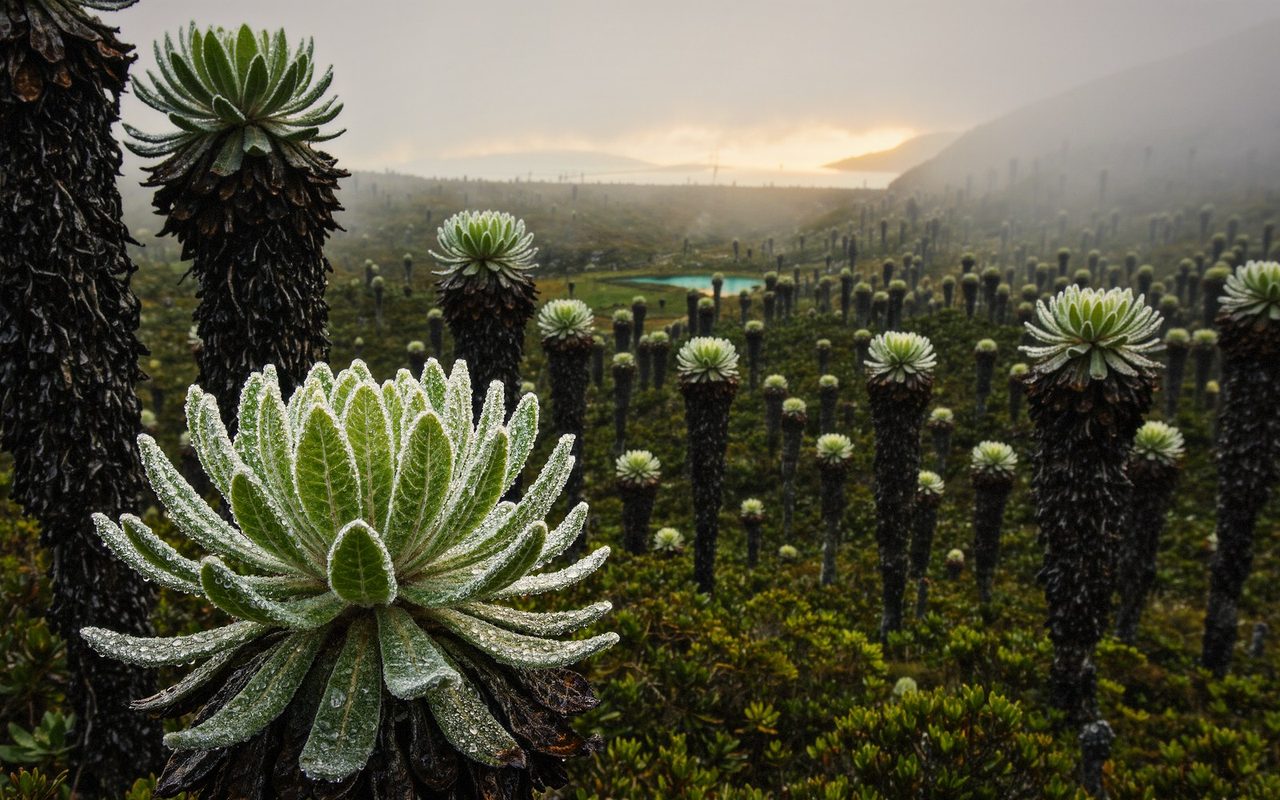
At 3,500 metres, in the middle of the mist, there are plants with furry leaves that look like hooded monks standing in line. They are not páramo decoration: they are the reason it rains downstream. Understanding them changes how you walk among them.
What a frailejón is
Frailejones belong to the subtribe Espeletiinae, a group of plants in the daisy family that exists only in the páramos of the northern Andes. According to the data analysis published by SiB Colombia in 2022, there is evidence of 98 different species in Colombia, and close to 74 percent of them, 73 species, are endemic: they grow only in this country. Semana puts the total across the Andes at around 170 species, confirming that Colombia holds a large share of the group's diversity.
Their look is unmistakable: a thick trunk wrapped in the dead leaves the plant never drops, crowned by a rosette of thick, velvety, silvery leaves. Every detail is an answer to cold, intense radiation and water that arrives as mist rather than rain.
Living sponges that grow a centimetre a year
SiB Colombia calls them "living water towers": their stems and fleshy leaves act as sponges that store water and later release it into the ecosystem. Their metabolism, the same source explains, responds quickly to climatic variation and regulates transpiration, so the plant helps buffer changes in páramo humidity.
What makes that service fragile is time. According to Semana, frailejones grow between one and three centimetres a year and can keep growing for up to 100 years. A two-metre frailejón is not a plant: it is a century of páramo. When someone treads on it, pulls it up for a photo or burns it, what is lost will not come back within a human lifetime. In a well-conserved páramo, SiB adds, there can be between 2,000 and 20,000 adult frailejones per hectare; that density is what keeps the soil moist and the water clean.
Half of the world's páramos
Colombia carries a disproportionate responsibility. On 11 December 2021, International Mountain Day, the Ministry of Environment recalled that the country holds 50 percent of the world's páramos: close to three million hectares, less than 3 percent of the mainland territory, spread across 37 complexes. The Humboldt Institute, with a slightly different delimitation, speaks of more than 2.9 million hectares in 36 complexes.
The dependency figures are what matter. According to Humboldt, the páramos supply water to 17 million people and to 16 of the country's main cities, including Bogotá, Cali and Medellín, and feed 73 hydroelectric plants; 400 of Colombia's 1,123 municipalities have jurisdiction over some páramo. The Ministry widens the view to the whole Andes range, which supplies water to around 75 million people.
A threatened family
SiB Colombia is clear: 55 frailejón species fall into some threat category, 15 critically endangered, 25 endangered and 15 vulnerable. The causes are well known: farming and cattle climbing ever higher, burning, mining, and a climate changing faster than a plant growing a centimetre a year can follow. Pests and fungi detected in several páramos in recent years add to the list.
Walking among frailejones
In Puracé National Natural Park, between 2,500 and 4,700 metres according to its official page, and in the Páramo de las Papas of the Colombian Massif, frailejones are the landscape of the walk. Andigena's rules are the páramo's rules: stay on the marked trail and in single file, do not touch the leaves, do not sit on the plants for a photo, light no fire, carry your rubbish back and walk slowly. The reward is watching up close how mist droplets gather on a leaf and slide to the ground. That is a river being born.
With Andigena
Frailejones appear on two Andigena experiences: "Puracé National Natural Park, mountain of fire" (three days, level 3) and the "Colombian Massif Expedition" (three days, level 4), both with certified guiding, medical assistance and environmental interpretation. Puracé details at /experiencias/pnn-purace/.
With Phoenix
Andigena is the official adventure partner of Phoenix Initiative Colombia. Fundación Phoenix Initiative Colombia works in Rivera, Huila, on its ecological restoration pillar, downstream of the páramos that feed the Magdalena; its presentation is at becomephoenix.com/en/foundation. Phoenix operates through two distinct legal entities, Fundación Phoenix Initiative Colombia and Fondation Phoenix Initiative France. Phoenix Oasis, a women's fitness oasis in Rivera, has announced its opening for 30 June 2028, with pre-booking and no payment.
Sources
- SiB Colombia, "Lo que dicen los datos sobre los frailejones", 2022, consulted 4 October 2026: https://biodiversidad.co/post/2022/datos-frailejon-biodiversidad-colombia/
- Semana, "El monje de los páramos", consulted 4 October 2026: https://www.semana.com/especiales/articulo/el-monje-paramos/125790-3/
- Ministry of Environment and Sustainable Development, "Tenemos el 50 % de los páramos del mundo", 11 December 2021, consulted 4 October 2026: https://www.minambiente.gov.co/tenemos-el-50-de-los-paramos-del-mundo-ministro-de-ambiente-en-el-dia-de-las-montanas/
- Humboldt Institute, "Instituto Humboldt presenta claves para la gestión local de los páramos en Colombia", consulted 4 October 2026: https://www.humboldt.org.co/noticias/instituto-humboldt-presenta-claves-para-la-gestion-local-de-los-paramos-en-colombia
- Parques Nacionales Naturales de Colombia, "Parque Nacional Natural Puracé", consulted 4 October 2026: https://www.parquesnacionales.gov.co/nuestros-parques/pnn-purace/
AI-generated mood image.
Sources
- https://biodiversidad.co/post/2022/datos-frailejon-biodiversidad-colombia/
- https://www.semana.com/especiales/articulo/el-monje-paramos/125790-3/
- https://www.minambiente.gov.co/tenemos-el-50-de-los-paramos-del-mundo-ministro-de-ambiente-en-el-dia-de-las-montanas/
- https://www.humboldt.org.co/noticias/instituto-humboldt-presenta-claves-para-la-gestion-local-de-los-paramos-en-colombia
- https://www.parquesnacionales.gov.co/nuestros-parques/pnn-purace/
Related articles
Journal · AI image
Training at 700 metres and hiking at 3,500: the body in the mountains
The real altitudes of the trip, from Rivera at 700 metres to the Laguna de la Magdalena at 3,327 and the Puracé volcano at 4,646, with sources, and how to prepare a páramo hike without medical promises: progression, acclimatisation, layers and water.
Journal · AI image
Puracé: the Andean condor and the páramo
A national park of 91,843 hectares between 2,500 and 4,700 metres, eleven volcanoes, hot springs and a small population of condors, Colombia's national bird. What to know before three days on the "mountain of fire".
Journal · AI image
Semana Phoenix: seven days of adventure with Phoenix and Andigena
The real Semana Phoenix programme as recorded in Andigena's guide: the Tatacoa by bike, Rivera, horse riding at Finca Don Pedro, paragliding at the Mano del Gigante and rafting at Paicol, with transport and safety handled by Phoenix. No invented dates.